Every time you drive over a pothole or take a corner at speed, your car’s springs are working hard behind the scenes. These crucial components form the backbone of your vehicle’s suspension system, yet many drivers know surprisingly little about how they work or why they matter so much.
Understanding your car’s spring system
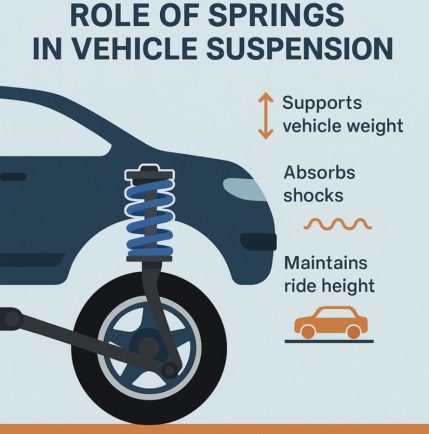
Vehicle springs serve three vital functions that directly affect your driving experience. As shown in the diagram above, springs support vehicle weight, absorb shocks from road irregularities, and maintain proper ride height. They prevent jarring impacts from reaching you and your passengers while ensuring your wheels stay in contact with the road surface for safe braking and steering.
Modern cars typically use coil springs, which look like large metal corkscrews positioned between the wheel assembly and the car’s body. Some vehicles also feature leaf springs, particularly trucks and commercial vehicles, while others use air springs that can adjust their stiffness automatically.
The science behind comfort and control
The magic happens through controlled compression and extension. When your wheel hits a bump, the spring compresses to absorb the energy. As it returns to its normal length, it pushes the wheel back down to maintain road contact. This process happens countless times during every journey, often without you noticing.
Recent research shows that engineers have attempted to maximize vehicle ride comfort through reducing the spring stiffness and increasing sprung mass and damping coefficients, but this creates a delicate balance. The spring rate – how stiff or soft the spring feels – determines much of your car’s character. Softer springs provide a smoother ride over rough surfaces but can allow too much body movement during cornering. Stiffer springs improve handling precision but may transmit more road noise and vibration into the cabin.
Studies indicate that the useful life of the coil spring was more than 625 times lower than the lower arm when driven on the flat road, whereas when driven on the rough road, the useful life of the coil spring was almost 3 times lower than the lower arm. This demonstrates how road conditions significantly impact spring longevity and performance.

“This infographic provides a concise overview of car springs. It explains What Springs Do (support vehicle weight, absorb shocks, and maintain ride height), illustrates Types of Springs (Coil, Leaf, and Air), and demonstrates How They Work through compression and extension.”
Latest developments in spring technology
The global automotive suspension market size was valued at USD 45.3 billion in 2022 and is expected to reach USD 51.6 billion by 2027, at a CAGR of 2.6% during the forecast period. This growth reflects the increasing investment in suspension technology and the demand for improved comfort and safety features.
Recent advances have transformed spring design and materials. Traditional steel coil springs now compete with composite materials that offer weight savings without compromising strength. Some manufacturers use progressive rate springs that become stiffer as they compress, providing both comfort and control.
Material innovations
Modern spring steel contains precise alloy compositions that resist fatigue and corrosion better than older designs. Research shows that the quest for lightweight, efficient, and corrosion-resistant coil springs has led to the exploration of alternative materials beyond traditional steel, with composite materials showing particular promise for three-wheeler vehicles and specialty applications.
Some premium vehicles feature titanium springs, which weigh significantly less than steel while maintaining excellent durability. Carbon fibre composite springs are emerging in high-performance applications, offering the ultimate in weight reduction while studies demonstrate their potential for cost reduction in light-duty vehicles.
Smart suspension systems
Active suspension technology represents the cutting edge of spring development. Research indicates that active suspension systems offer substantial benefits in ride comfort and handling control over traditional passive systems. These systems use electronically controlled dampers that work with the springs to adjust suspension behaviour in real-time. Some systems can even predict road conditions using cameras and adjust accordingly.
Semi-active suspension systems have moved from research laboratories to mass-market applications, providing a balance between performance and cost-effectiveness that makes advanced suspension technology accessible to everyday drivers.
Expert insights from engineering excellence
Leading automotive engineers emphasise that spring development focuses on three key areas: reducing weight, improving durability, and enhancing performance consistency. Research shows that through utilizing developed multiple regression models, spring fatigue life can now be predicted under constrained suspension parameters, helping engineers optimize designs before physical testing.
Dr Sarah Mitchell, suspension specialist at a major automotive manufacturer, explains: “We’re seeing significant improvements in spring manufacturing precision. Computer-controlled winding processes ensure each spring meets exact specifications, leading to more predictable handling characteristics.”
The materials science behind modern springs has evolved considerably. Engineers now use computer modelling to predict how different steel compositions will behave under various loads and temperatures. Studies demonstrate that suspension parameter effects toward spring fatigue life are significant, serving as crucial guidance for suspension designers who must balance comfort and durability.
Hot-forming techniques create springs with varying thickness along their length, allowing engineers to fine-tune the spring rate curve. This technology enables a single spring to provide multiple characteristics depending on how much it’s compressed.
Maintenance guide for keeping your springs in top condition
Proper spring maintenance extends their lifespan and maintains vehicle safety. Visual inspection should be part of regular servicing, looking for signs of cracking, corrosion, or unusual wear patterns.
- Warning signs to watch for
Several symptoms indicate potential spring problems. If your car sits lower on one side, a spring may have broken or sagged. Unusual bouncing after hitting bumps suggests worn springs or related components. Metallic noises during suspension movement often point to spring or mounting issues.
- Professional assessment
Spring diagnosis following advice from onlinecarparts.co.uk should involve checking for proper ride height, spring compression rates, and mounting point condition. Many spring problems develop gradually, making professional inspection valuable for early detection.
Regular cleaning helps prevent corrosion, particularly important for vehicles exposed to road salt during winter months. Protective coatings applied during manufacturing provide initial protection, but this can wear away over time.
The safety connection
Worn or damaged springs compromise vehicle safety in multiple ways. Reduced road contact affects braking performance and steering precision. Excessive body movement during cornering can destabilise the vehicle, particularly during emergency manoeuvres.
Spring failure can cause sudden changes in vehicle height and handling characteristics. In extreme cases, a broken spring can damage other suspension components or even puncture a tyre.
Looking forward to future innovations
The next generation of spring technology promises even greater sophistication. Adaptive springs that change their characteristics based on driving conditions are under development. These systems could provide limousine-smooth comfort during highway cruising and sports car precision during spirited driving.
Integration with vehicle stability systems will become more sophisticated, with springs and dampers working together with electronic controls to optimise handling and safety simultaneously.
Research continues into shape-memory alloys that could revolutionise spring design. These materials can change their properties in response to temperature or electrical signals, potentially eliminating the need for complex mechanical adjustment systems.
Conclusion
Your car’s springs represent a perfect blend of mechanical engineering and materials science. While they work silently in the background, their contribution to driving comfort, safety, and vehicle longevity cannot be overstated.
Understanding how springs function helps you make informed decisions about maintenance and replacement. As technology continues advancing, tomorrow’s springs will provide even better performance while lasting longer and weighing less.
Regular inspection and proper maintenance ensure your springs continue delivering the smooth, controlled ride they were designed to provide. When the time comes for replacement, modern spring technology offers improvements that enhance every aspect of your driving experience.