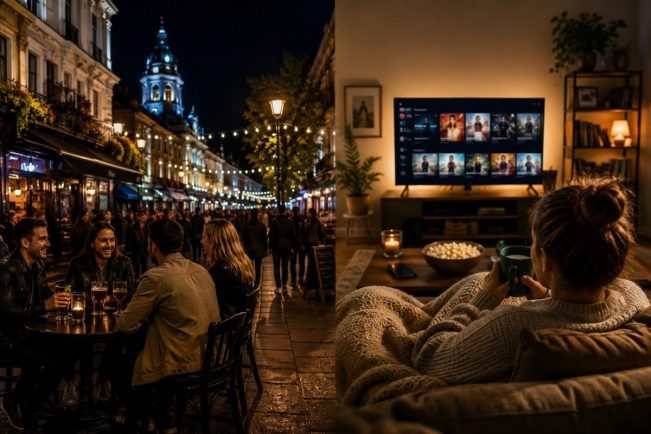
Royal Leamington Spa has long prided itself on a lively town centre.
The Parade and its surrounding streets offer a dense cluster of independent pubs, bars and eateries that draw both locals and visitors throughout the week.
Yet something is shifting. Increasingly, the question isn’t just where to go on a Friday night — it’s whether to go out at all.
This isn’t a uniquely Leamington story, but the town offers a vivid illustration of a tension playing out across the UK: a genuine appetite for socialising and shared experiences bumping up against financial realities and the extraordinary convenience of modern home entertainment.
The pull of Leamington’s social scene
Leamington’s hospitality district remains a genuine draw. Venues off the Parade have responded to changing tastes by combining food, craft drinks and live music into evenings that feel like more than just a round at the bar. The pitch to residents is clear: this is an experience you can’t replicate on the sofa.
The regional numbers support that ambition. South Warwickshire attracted over 9.9 million day trips in 2024, a 12% rise on the previous year, with total visitor spend reaching around £860 million. That figure signals genuine, sustained demand for local days and nights out — and Leamington’s bars, restaurants and venues sit squarely within that ecosystem.
Why more residents are staying home
Despite that encouraging picture, a countervailing pull is hard to ignore. The cost-of-living squeeze has fundamentally altered how many households approach discretionary spending. A night out — drinks, transport, perhaps a meal — now carries a price tag that’s increasingly hard to justify on a regular basis. For many residents, going out has become an occasional treat rather than a weekly habit.
The breadth of what’s accessible from a living room — at a fraction of the cost of a night out — is genuinely remarkable. According to Statista’s ONS-based data, 55% of households in Great Britain had cut back on non-essential spending by early 2025, a category that directly includes pubs, bars and leisure activities.
Digital entertainment options filling the gap
The home entertainment landscape has expanded enormously to fill that space. Streaming platforms, on-demand sport, online gaming and an ever-wider range of digital leisure activities now compete directly with the town centre for residents’ evenings. Even niche entertainment formats have found mainstream audiences: options available on aviator casinos illustrate how broad the digital leisure ecosystem has become, spanning everything from casino-style gaming to competitive titles.
The data on home entertainment consumption makes the picture even clearer. Ofcom’s Media Nations analysis found that the average person in the UK spent four hours and thirty minutes per day watching TV and video at home in 2024, with streaming services accounting for around 40 minutes of that daily total. According to Ofcom’s 2025 findings, YouTube has also become the UK’s second most-watched video platform by viewing share, underlining how on-demand content has reshaped the default evening.
For Leamington residents, this translates into a very specific competition. A household with multiple streaming subscriptions, a food delivery app and a comfortable living room has, in practical terms, access to a full evening’s worth of entertainment without leaving home. The convenience argument is almost impossible to counter — and it grows stronger each time a streaming service drops a major new series or a big sporting event lands on a platform people already pay for.
What this shift means for local venues
The structural pressure on nightlife is well documented at a national level. Research cited by the Night Time Industries Association found that more than 480 nightclubs closed across Britain between 2020 and mid-2024, representing the loss of over a third of the country’s club spaces. Independent venues in smaller towns like Leamington face the same cost pressures — rising energy bills, business rates and wage costs — but with a more limited local catchment to absorb them.
The response from Leamington’s hospitality community has been to double down on experience. BID Leamington and local operators continue to invest in events, place-making and marketing designed to give residents compelling reasons to choose a night out over a night in. Live music, themed events and independent craft offerings are the current playbook — and for a town with Leamington’s character and footfall, it remains a credible one. Whether it proves enough to reverse the broader trend is a question the whole sector is watching closely.