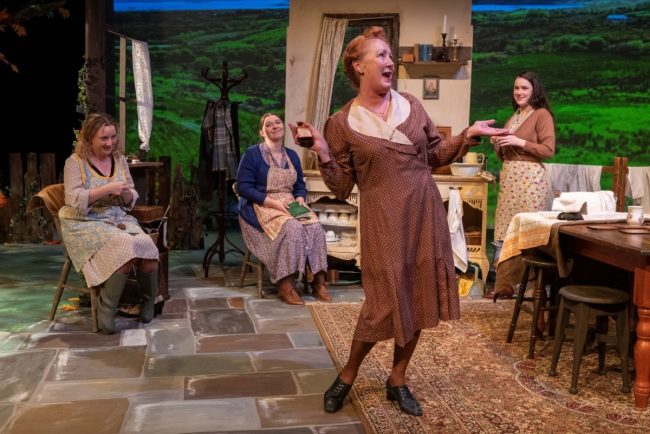
IF you are looking for a first class night of heart-warming entertainment and as much intellectual stimulation as you care to indulge in, then The Loft’s production of Brian Friel’s play Dancing at Lughnasa is certainly something you won’t want to miss.
The play is a masterclass in writing for the stage and Brian Friel’s ability to play with time, structure and our perceptions, within what appears to be the fairly standard format of an ensemble piece with a narrator and the use of one set, is deceptive.
The play operates on myriad levels. We view the world of this rural Irish family of five sisters through the ‘memoryscape’ of Michael, aged seven at the time we enter their world, but now an adult, looking back on those rather dark days of the 1930s. A world in flux. The internal strains of the family, struggling to survive economically, socially and emotionally in a changing world, as symbolised by the ownership of a new valve radio, is further, and more immediately revealed by the arrival of Jack, the elder brother, returning from missionary work in Uganda. The sisters held together by the blood that binds, are also struggling with their own desires and dreams and raising Michael, Chrissie’s son by an intermittent father, who comes and goes: Promising much and delivering little. Gerry is both infuriating and endearing, qualities captured with incision by Ted McGowan.
This is an ensemble performance, excellently portrayed by a cast, who understand the dynamics of family and who can be both loving and vicious as only siblings can be. Resentful and forgiving. The sisters are played wonderfully well, all distinct characters, individually powerful, but together quite indomitable.
The arrival of Jack, bringing alternative views on religion and culture from Uganda, is at once disturbing but also refreshing to the sisters and to the audience. Phil Reynolds captures the development of Jack, from a man dithering in his own conflictions through to a man who is now firm in his views and in his rejection of his own religion. He, just like the ‘cuckoo in the nest,’ the new-fangled radio, begins to undermine their claustrophobic convictions.
Christopher Stanford plays the adult Michael, the narrator of the play, with a profound detachment, delivering the closing monologue a powerful piece of writing which, in essence, defines the play, with a conviction that reaches out to the audience. Our memories are not always accurate. As Michael says, ‘atmosphere is more real than incident and everything is simultaneously actual and illusory.’
Spencer Watson