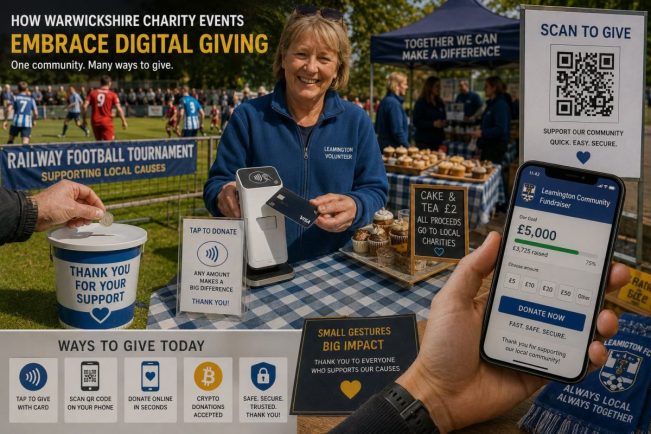
Anyone who has stood pitchside at the Railway Football Tournament knows the routine.
There is the rattle of a collection bucket making its way down the touchline, the raffle tickets passed around at half-time, and the cheerful volunteer at a fold-out table taking cash for a tea and a slice of homemade cake.
For decades this has been the quiet engine room of community fundraising across Warwickshire, from the football clubs of Leamington to the bowls greens of Warwick. Yet the way people actually hand over their money has shifted, and the bucket now sits next to a contactless card reader and a QR code printed on laminated card.
That same appetite for quick, frictionless online entertainment has reshaped how Warwickshire residents spend their leisure money more broadly, and digital habits learned at one screen tend to travel to another. The rise of cryptocurrency has fed into this, which is why review guides ranking the best Crypto casinos for UK players have grown into a genuine resource for the curious. These 2026 guides test sites on the speed of withdrawals, the fees attached to deposits, the breadth of the game libraries spanning slots, table games and live dealer rooms, and the quality of customer support, then publish ranked recommendations so a reader can see at a glance what holds up under scrutiny and what does not. For anyone weighing whether digital wallets and tokens have a place in their own leisure time, that kind of tested, plain-spoken comparison answers the questions a casual onlooker would otherwise have to puzzle out alone.
The Bucket Has Gone Cashless
The shift away from coins did not happen overnight, but it has been brisk. Footfall at a charity stall used to depend on whoever happened to have loose change, and in an age where many people leave the house without so much as a fiver, that was becoming a problem. Local organisers noticed donations dipping not because generosity had faded, but because nobody was carrying cash.
Contactless readers solved the immediate hurdle. A volunteer at a Warwickshire cricket club fundraiser can now take a tap-and-go donation in seconds, and the donor barely breaks stride. QR codes have pushed this further still, letting someone scan a square on their phone and land directly on a giving page while the match carries on around them.
From Touchline to Tap
The Railway Football Tournament is a useful example of the change in miniature. A grassroots event built on community spirit, it has always relied on small contributions adding up. Where once that meant counting coppers at the end of the day, organisers can now watch a running total tick upwards on a screen, complete with a thermometer-style graphic that supporters seem to find oddly compelling.
Research into giving behaviour suggests this is not a coincidence. Studies on digital giving in the arts and cultural fundraising have found that visible, real-time progress encourages people to chip in, because they can see the difference their contribution makes. A pound dropped in a bucket vanishes anonymously. A pound that nudges a progress bar closer to its goal feels like part of something.
Why Online Entertainment and Giving Now Share a Toolkit
There is a neat overlap between how Warwickshire residents are entertained online and how they are asked to give. Both rely on slick, mobile-first design, instant payment options and the reassurance that money moves safely. The skills people pick up streaming a film, ordering a takeaway or topping up a digital wallet transfer directly to the act of donating.
Academic work exploring the online charitable giving landscape has mapped just how varied these channels have become, from social media appeals to in-app prompts and one-click pledges. The common thread is convenience. When the barrier to giving drops to a single tap, more people clear it, which is precisely why local clubs have leaned into the technology rather than treating it as a gimmick.
The Psychology of a Single Tap
There is something worth pausing on in the way these small, friction-free moments add up. Behavioural researchers have looked closely at why a quick digital prompt loosens the purse strings more readily than a formal letter or a standing collection. The BBC has reported on how charity apps boost generosity, pointing to round-up features and gentle nudges that fold giving into everyday spending without it ever feeling like a sacrifice.
For a Leamington fun run or a Warwick District community appeal, this matters enormously. A donor who might never write a cheque will happily round up a coffee purchase or tap a card at a finish line. The sums look trivial in isolation, yet across an entire event they form a substantial chunk of the final total. Generosity, it turns out, responds to ease.
Keeping the Community Feel Intact
None of this means the human warmth of a Warwickshire fundraiser has been lost. The card reader sits beside the cake stall, not in place of it. The QR code is held aloft by a smiling volunteer, not a faceless screen. Organisers have been careful to keep the personal touch that draws people to local events in the first place, while quietly modernising the mechanics underneath.
The next Railway Football Tournament will still smell of fresh-cut grass and bacon rolls, and supporters will still cheer a last-minute goal. What has changed is invisible until the moment someone wants to give. Then the choice is theirs: a coin in a bucket, a contactless tap, a phone scan, or a digital wallet transfer made in seconds. Each route leads to the same place, and that flexibility is exactly what keeps the money flowing and the community spirit thriving across Leamington and the wider county.