Driftwood
The Other Place, Stratford
THE NOTION of independence, its glittering prizes, struggles and ultimate responsibilities, runs through Martina Laird’s fine, thought-provoking debut as a writer at the RSC.
Trinidad in the 1950s was a nation craning its neck to see over the fence of British colonial rule and take in the possibilities offered by standing in the world on its own two feet.
The hopes, dreams and failings of a working family in the island’s capital mirror the nation’s battles to pin down an identity and make the move into the next phase, united by some things, divided by others.
Mother Pearl and estranged siblings Ruby and Diamond all have a desire to make it in the world but represent different ways of achieving that. Like the precious jewels after which they are named, they all also have their defining faults.
Under the brooding presence of colonial rule in the shape of British property owner Mansion and US free-marketeer Tom and his navy crew, the trio variously explore the moral question of ownership, the promise of political change, the expediency of grasping whatever you can and the ever-present option of just getting away to some notional better place.
Pearl, a fine performance from Ellen Thomas, believes the life she has dedicated to raking in the cash for the house’s lazy, complacent owner gives her right of eventual ownership. Ruby (Cat White) has few qualms about ditching her mother’s subservience for some kind of better business deal and her recently-discovered brother Diamond is quick to abandon cooperation for the more short-term pragmatism of dealing outside the law.
All in their various ways come up against opposition equally from within the family and from the outside powers whose understanding of moral and supportive intervention comes, as it always does with colonialism, a poor second to the benefits of exploitation.
Ultimately the efforts to wrest control are dealt with in a manner redolent of the brutal picture of forced occupation painted nearly fifty years ago in the Romans in Britain. Unseen but deeply shocking nevertheless.
Perhaps the outcome is as humiliating and dispiriting as it should be and the knowledge that independence for the nation coming only a decade later would not be without its costs, but there is redemption and hope enough to provoke thought.
This is a fine production which, under director Justin Audibert, makes excellent use of the Other Place’s intimate dimensions but would, in truth, be perfectly at home in a larger theatre.
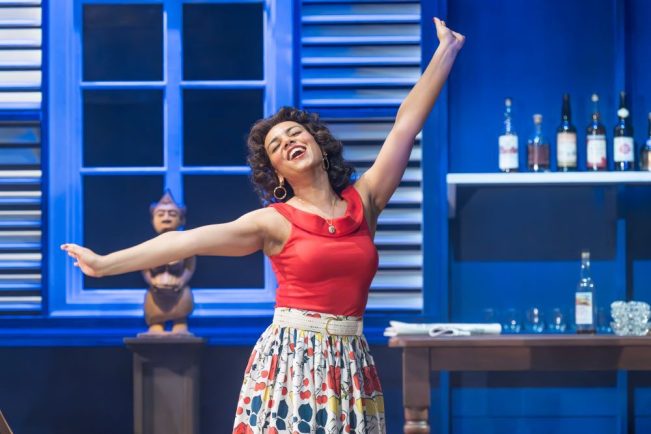
Sadeysa Greenaway-Bailey’s design brings something not often seen these days in Stratford, a box set. A lovingly realised island interior whose walls expand and contract perhaps to underline the restrictive nature of political hegemony. Fine details and wonderfully atmospheric lighting provide a compact and at times stifling background for the action.
The script’s unwavering use of Trinidadian patois, coupled with a cast whose performances are firmly embedded in the language’s rapid delivery, may mean concentration levels have to be high but, despite some things inevitably being lost, the authenticity is worth the effort.
With some delightful moments of comedy scattered throughout this play, and this production particularly, offers a glimpse of a world and a world-view which will stay long in the mind.
Matthew Salisbury