President Donald Trump has secured a major diplomatic breakthrough in the Middle East after a peace agreement between the United States and Iran came into immediate effect, bringing an end to the conflict and paving the way for the reopening of the strategically vital Strait of Hormuz.
The agreement, known as the Islamabad Memorandum of Understanding, was announced by Pakistani Prime Minister Shehbaz Sharif, who acted as a mediator between the two sides.
According to Mr Sharif, the deal came into force immediately and would help create greater stability across the region.
He said:
“As a first step, Islamic Republic of Iran will instantly reopen the Strait of Hormuz and the United States of America will immediately lift the naval blockade.”
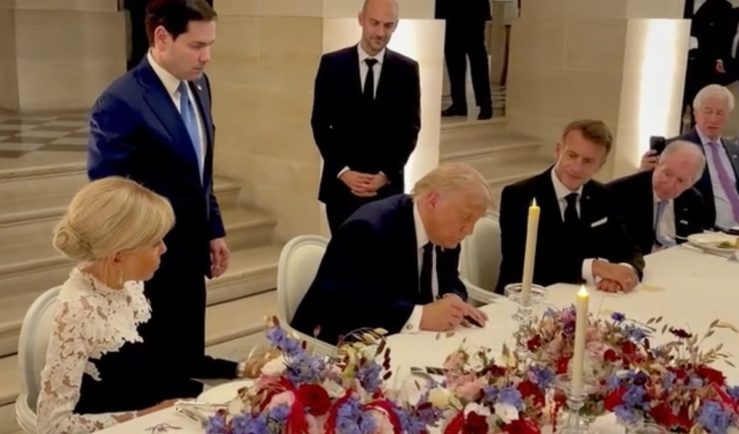
In a symbolic move, President Trump travelled to the Palace of Versailles in France, where the treaty ending the First World War was negotiated, to formally sign the agreement while attending the G7 summit. Iranian officials later confirmed that President Masoud Pezeshkian had also signed the memorandum.
The breakthrough follows days of intense diplomacy and marks a significant moment for the Trump administration, which has sought to combine military pressure with negotiations in an effort to curb Iran’s nuclear ambitions while avoiding a wider regional conflict.
President Trump described the agreement as a major success.
He told reporters:
“Iran cannot have a nuclear weapon, they can’t develop it, buy it, they can never have a nuclear weapon.”
He also argued that the deal achieved Washington’s objectives while avoiding potentially severe economic consequences.
“The one president I did not want to be was the late great Herbert Hoover,” Mr Trump said, referring to concerns about the potential impact of prolonged instability on the global economy.
The Strait of Hormuz is one of the world’s most important shipping routes, carrying a substantial proportion of global oil and gas supplies. Its reopening is expected to ease concerns about energy markets and international trade.
Praise for Trump’s Diplomacy
Mr Sharif praised President Trump’s role in securing the agreement, saying his commitment to diplomacy had helped avert a much wider crisis.
“Mr Trump’s steadfast commitment to diplomacy and preference for peaceful resolution have once again helped end a conflict that could have led to devastating consequences for the region and beyond,” he said.
The Pakistani leader also congratulated Vice President JD Vance, special envoy Steve Witkoff and Jared Kushner for their involvement in the diplomatic effort.
Support for the agreement was also voiced by French President Emmanuel Macron, who described it as “excellent” during remarks at the conclusion of the G7 summit.
“This is an agreement we support, because it’s one that puts an end to a situation of huge instability with major impacts on our economies, as you can see, all of you, day in and day out,” Mr Macron said.
The G7 nations also issued a joint statement praising President Trump’s leadership in securing the agreement.
Questions Remain
Despite the breakthrough, some questions remain about the long-term durability of the agreement.
Senior figures within the US administration are reported to have expressed concerns about whether Iran will ultimately accept further concessions regarding its nuclear programme when negotiations on a more comprehensive settlement begin.
The agreement reportedly includes provisions relating to enriched uranium, sanctions relief and maritime access through the Strait of Hormuz, though the full text has not yet been released publicly.
President Trump made clear that Washington expects compliance.
“It’s a memorandum of understanding. If it doesn’t get done in 60 days, that’s all right, we go back to bombing,” he said.
A Defining Foreign Policy Moment
For supporters of the President, the agreement represents another example of Trump’s willingness to combine strength with negotiation, using American leverage to bring adversaries to the table while seeking to avoid a prolonged conflict.
After days of discussions with world leaders at the G7 summit, President Trump said international partners had warmly welcomed the agreement.
“The past few days have provided a chance to discuss the details of the deal with the closest friends and allies, the heads of countries,” he said.
“They love this deal.”
If successfully implemented, the agreement could mark one of the most significant diplomatic developments in the Middle East in recent years, easing tensions in a region that has often been a flashpoint for global instability.