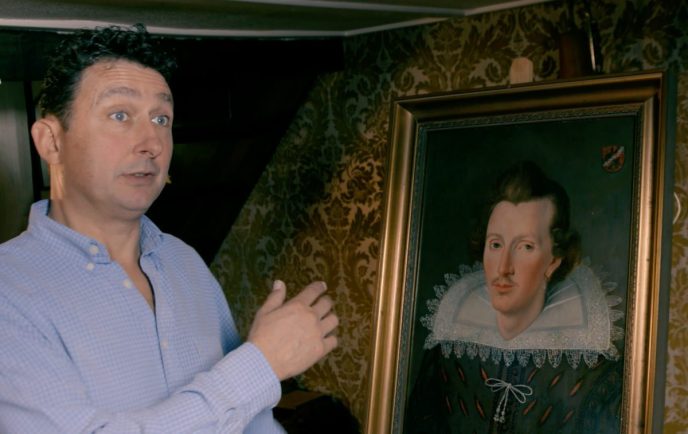
A WINDOW cleaner who believed a “scary” painting hanging in his living room has been told he could have a portrait of Shakespeare.
Steven Wadlow has been around the houses trying to confirm what he originally thought was merely a family heirloom is actually the only portrait of William Shakespeare painted in his lifetime.
And after a trip to Paris, Steven was told by art experts it appeared to be a portrait of the Bard, aged 31, with hair and no beard.
Steven, from Aylesbury, said: “I didn’t particularly like it because it used to scare me, wherever you are in the house, it’s looking at you. It always used to remind me of those portraits on Scooby Doo.”
Steven’s journey into the art world began unexpectedly when his father was watching an episode of Time Team.
He explained: “One night over 11 years ago, mum and dad were watching a programme about Stratford-upon-Avon when they noticed a painting with a familiar face. My dad phoned me the next day and said, I think the painting in the corner might be Shakespeare.”
A few days later a visiting English and Art lecturer agreed, sparking a 12 year investigation into the painting’s origins.
The portrait underwent extensive scientific analysis at some of the world’s leading art institutions including the Hamilton Kerr Institute and UCL.
Cutting edge technology revealed underdrawings, including a mysterious coat of arms and overpainting that had been added, it was speculated, in order to disguise the true identity of the sitter for whatever reason.
Steven’s father bought the painting for £900 in the 1960s from art restorers working on the Great Tew estate near Banbury, which was once known to have once been home to a portrait of Shakespeare.
But there was one big problem – the establishment refused to accept a portrait of Shakespeare with hair and no beard.
The break-through moment came when Steven took the portrait to Lumiere in Paris for more cutting edge tests. Lumiere have handled thousands of the greatest artworks in the world including the Mona Lisa and their results led to the conclusion that Steven’s portrait depicts Shakespeare as an actor, playing a role in one of his own plays.
Steven added: “That was an amazing day. After all these years and all the, is it Shakespeare? Isn’t it Shakespeare? And then today we have Jean, who discovered the under drawings on the Mona Lisa, saying that our painting is Shakespeare. You just can’t get better than that.”