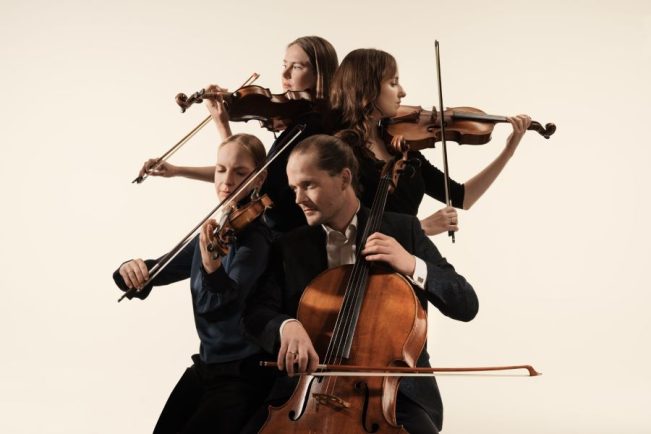
MANY claim Schubert’s C Major outing to be the finest quintet written, offering a wonderful range of harmony, rhythm and melodic variation. It’s certainly a staggering achievement, but to succeed fully it still needs to be played and it can hardly have had many better treatments than this astonishing reading from the Dudok and Pieter Wispelwey.
Schubert’s masterwork formed the finale of a concert which had already given so much. Pieces from Rameau and Dowland – the latter a selection from his settings of The Seven Teares which sparkled and lamented in equal measure with a delicious early music texture and sound.
All playing on gut strings but with a variety of bows and a line-up that puts the cellos central and the viola to the side, the Dudok are clearly a quartet who like to do things their way, even having one standing member among the remainder seated.
And there’s a similarly quirky, uniqueness to the way they play. From the off the approach was fundamentally relaxed, not lazy or underpowered, just relaxed with a sense of letting the music find its best voice in the acoustic.
Mozart’s Quartet No 21 Prussian showcased the musicianship the quartet has to offer. There is a wonderful breadth to the dynamics these four can achieve not just in terms of volume but in terms of an almost palpable softness so delicate placed.
Impressive too is the immaculate intonation throughout, not so easy when the gut-strung cello is asked to leap between octaves with precious little to hide behind. In an acoustic as unforgiving as a large church this was simply faultless.
But it will surely be the closing Schubert that will live longest in the memory. The monumental first movement was testimony to the sheer weight of work this group has put into preparing for the recording studio. Again the spirit is stirred by the wonderful attention to detail, forging strength to gather and then sitting back in the gentlest of registers.
The signature second movement just surpassed everything. This elegiac progression of melody and variation was a favourite of Leamington Music’s much-missed leader Richard Phillips – and was most movingly played at his memorial service.
Strange to relate among such a wealth of string tonal colour but the abiding memory in this adagio could well be one of just how varied and convincing the pizzicato playing was. No pair of thumbed notes sounded the same and the emotion conveyed by this often percussive playing was simply astounding.
Rounded off perfectly and with a sense equally of concentration and celebration this was a performance to treasure.
It’s at moments like this that it’s a blessing no encore was given as nobody would wish to have anything take away the memory of such a stunning feast.
Visit leamingtonmusic.org for details of further concerts in this series.