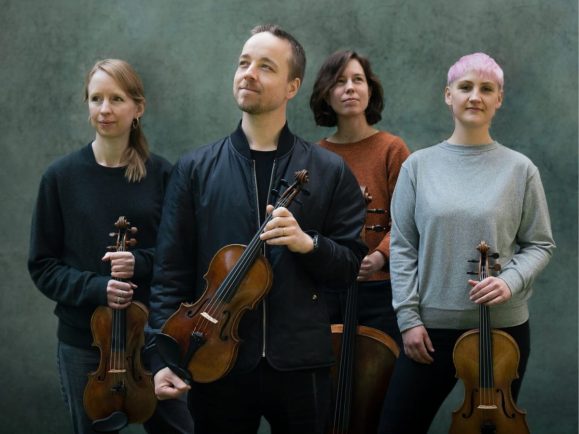
WITH the continued insistence of Storm Claudia threatening to force its way through the church roof, those inside faced a task in separating the subtle strains of musical sound from nature’s own thundering drum kit above.
The Gildas Quartet brought a mixed programme and a delightfully involved quality of playing to a concert which certainly rewarded those willing to dig out the waterproof layers.
Jessie Montgomery’s opener Strum and the Alwyn quartet with which it shared the first half have quite a lot in common despite coming from different lands and, to some extent, different eras.
Establishing rhythm involves, for both, a hefty reliance on pizzicato playing to hammer out an almost percussive underpinning with melodic suggestions above and whatever resources remain given the task of filling out the resulting void.
The effect of such separated dynamics is to produce a rather stretched sonic texture, plenty at the bottom and top but with little to link them. This is music for the quartet playing almost as four distinct elements and the task showed on the faces of the group, clear concentration but little evident joy.
Alwyn’s rapid transference of responsibility for handling the drive behind the music brought out the best from the quartet in terms of brilliantly sharp precision.
Both pieces impressed, despite the quartet’s own slightly tongue-in-cheek observation that most of those present will have been waiting for the safer ground of Beethoven in the second half.
Alwyn is a composer whose output is sufficiently abundant to make exploration beyond this Quartet No 1 assured of finding something very good, and many will have made a mental note to do just that.
Beethoven, of course, never undersells when it comes to either quality or quantity and the wide expanses of his Quartet No 9 Rasumovsky offers all the extended openings and drawn-out conclusions that allow a quartet to build and express.
And the Gildas certainly made the most of such rich territory. The texture here is so much more closely-woven, the group sounding on occasions more like a full string section than four individuals.
Particularly impressive was the slower second movement. In this, and later passages, the cello alternates between beautifully attenuating series of pizzicato plucks and steady underpinning bass lines more redolent of swing jazz than chamber music.
Blasting through the many recapitulations and final approaches to the summit, this was playing of a freshness and commitment strong enough to push the rising flood tides out of mind.
Another excellent contribution to this fine series of concerts which continues in its chamber guise in the new year, before which there are plenty of festive treats with leamingtonmusic.org supplying all the programme and booking details.