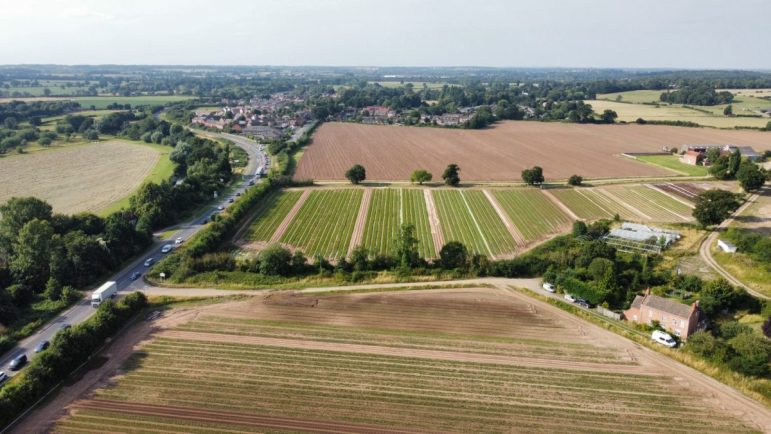
CONTENTIOUS plans for a sand and gravel quarry near Barford could signal the last harvest from highly productive farmland.
Campaigners warn the Smiths Concrete proposal for the quarry at Wasperton Farm would see the total and permanent destruction of 220 acres of rich farmland currently used to grow three to four salad vegetable crops each year.
At a time of increased risk to UK food security, the campaign group claim the loss of such valuable land must not be allowed to happen when the UK population was increasing rapidly, climate change was driving more extreme weather, and the government was calling for UK farmers to adopt sustainable and more climate-resilient farming practices.
The campaigners point to DEFRA’s new UK Food Security Index 2024, which while indicating a broadly stable picture, notes the amount of UK land in production has seen a gradual decrease over the last 40 years. Since 2022 land used for horticultural crops has decreased by 5.2 per cent, which is a larger decrease than any other land use sector.
The UK produces 55 per cent of the vegetables and 17 per cent of the fruit it consumes. The Wasperton Farm quarry site is classified as “best and most versatile” agricultural land but is included in Warwickshire County Council’s Minerals Plan.
If given the go-ahead, Smiths Concrete plan to extract 2million tons of aggregates, for up to 15 years, which campaigners argue poses a health risk to residents in Barford and Wasperton.
Bill Young, an agribusiness consultant and an expert in sustainable regenerative agriculture, said: “It makes no sense to compromise UK food security by turning some of the best and highly productive farmland into quarries or renewable energy sources.
“If the quarry is allowed to go ahead, eventually the quarry site will be filled in with inert materials and is extremely unlikely to be useable for farming crops again. The loss would be permanent. This prime land must remain in agricultural production.”
But Smiths Concrete has long argued it has “developed robust proposals” that included much of the site remaining agriculturally productive over the anticipated 15 years of operation, with a measurable biodiversity uplift during and post-extraction.