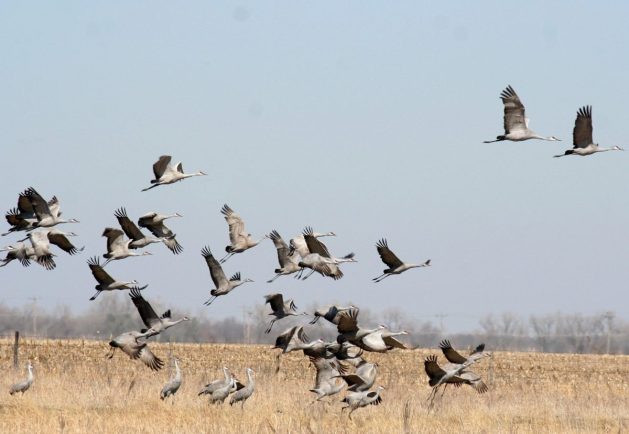
A bird once lost from the British landscape is staging a notable comeback, with cranes now reappearing across the UK countryside.
After vanishing from the UK around 400 years ago, largely due to over hunting and widespread loss of marshland, the species is now recovering through a mix of natural recolonisation and coordinated conservation work.
The modern return of cranes began in the late 1970s, when birds gradually spread from continental Europe into eastern England. Since then, targeted reintroduction programmes and habitat restoration have accelerated their recovery, particularly in areas such as Suffolk, Somerset and Gloucestershire.
One of the most prominent success stories is at the RSPB’s Lakenheath Fen reserve in Suffolk, where careful land management has created ideal conditions for breeding cranes. The site, once arable farmland, has been transformed into a mosaic of reedbeds, open water and wet grassland.
Dave Rogers, reserve manager at Lakenheath Fen, said:
“We talk about the UK as being a very nature-depleted country, so getting something back as iconic as cranes shows we can change the fortunes of a landscape, and change the fortunes of a species.
“They’ve been lost for 400 years, to reverse that decline shows that humans can reverse some of the impacts they’ve had.”
Cranes, the tallest flying birds in the UK, stand at around one metre in height and can reach a wingspan of up to two metres. Their loud, trumpeting calls, often described as bugling, can travel several miles across open wetlands, while their elaborate courtship dances, involving leaps and wing displays, are a defining feature of their behaviour.
Recent figures highlight the scale of the recovery. Conservationists recorded 87 breeding pairs across the UK last year, raising 37 chicks. The total population is now estimated at around 250 birds, including both adults and younger individuals. This marks a significant increase from just a handful of pairs a few decades ago.
One resident near Redditch in Worcestershire described a recent encounter at her home.
“It was standing by my pond and gave me a bit of a shock as it was so large. It looked almost prehistoric. But it was magnificent to see as it scored off into the Worcestershire blue skies. I don’t think it took any of my fish but I think that’s what he was eyeing up so I’m keeping a look out in case he comes back again.”
At Lakenheath Fen, cranes were initially attracted by the presence of young reeds and shallow water during the reserve’s early development. Ongoing management has helped sustain their presence, with winter reed cutting creating safe landing zones and secluded nesting areas maintained in shallow flooded habitats.
The broader recovery effort has been supported by the Great Crane Project, a partnership involving the RSPB, the Wildfowl and Wetlands Trust and the Pensthorpe Conservation Trust. The initiative has focused on habitat creation, cooperation with farmers and the release of hand reared birds, particularly in the Somerset Levels.
Today, at least 80 percent of the UK’s breeding cranes are found on protected land, with roughly a third located on RSPB reserves such as Lakenheath Fen and West Sedgemoor.
Despite these gains, conservationists warn the species remains vulnerable. Wetland habitats are increasingly threatened by climate change, including rising sea levels, drought and shifting weather patterns.
Martin McGill, reserve manager at WWT Slimbridge, Gloucestershire, said:
“Their habitats are at risk from the ever-increasing impacts of climate change – making it more important than ever to come together across sectors, to protect and restore bigger, more connected wetlands, so this iconic bird can thrive long into the future.”
The return of cranes is widely seen as a rare conservation success in the UK, demonstrating that large scale habitat restoration can bring back species once thought lost. Their growing presence across Britain’s wetlands offers both a symbol of ecological recovery and a reminder of the work still needed to secure their future.